










I was thirty, and it was spring, when my life changed: this Magic Mountain became my home.
I had been living in Delhi for over two years, writing publicity briefs for the international relief agency CARE, and not at all happy doing it. If I was going to write reams of self-congratulatory hand-outs, I told myself, I might as well be doing my own writing, even if it meant a drop in my income. Early in the April of 1963, I was sent to Mussoorie to write about CARE’s Tibetan relief programme, especially for the refugee children. Their education was being sponsored at the Wynberg Allen School, where I was to meet the principal, and he asked me to lunch. He had also invited an old lady, Miss Bean. She lived alone in a cottage below the school, and the teachers were kind to her because she had very little money. The principal had told me, before she arrived, that she had lost all her property and had no relatives.
Miss Bean was 86 and slightly built. She looked fragile but was surprisingly sprightly. She told me she had lived in Mussoorie all her adult life, and though she’d had to sell her house, she was lucky that a friend who owned a couple of homes in Mussoorie had asked her to stay rent-free in one of them and look after it. When I mentioned that I was thinking of giving up the CARE job and moving to Dehradun or anywhere nearby, she said the cottage was vacant, except for two little rooms on the ground floor where she lived, and would I like to see it. I said I would, and after lunch we walked down to her abode.
That was when I first saw Maplewood Lodge, which became my home for almost a decade and where I wrote most of my short stories. At that time of the year, the surrounding forest was at its best – the oaks and maples in new leaf, the oak leaves a pale green, and the maple leaves red and gold and bronze. This was the Himalayan maple, quite different from the North American maple; only the winged seed-pods are similar, twisting and turning in the breeze as they fall to the ground, so that the Garhwalis call it the Butterfly Tree.
There was one very tall, very old maple above the cottage, and this was probably the tree that gave the house its name. A portion of it was blackened where it had been struck by lightning, but the rest of it lived on, a favourite haunt of woodpeckers: the ancient peeling bark seemed to harbour any number of tiny insects, and the woodpeckers would be tapping away all day to prise them out. A steep path ran down to the cottage. During heavy rain, it would become a watercourse and the earth would be washed away to leave it very stony and uneven. Actually, the path ran straight across a landing and up to the front door of the first floor. It was the ground floor that was tucked away in the shadow of the hill; it was reached by a flight of steps going down from the path.
That first afternoon, I helped Miss Bean up the steepest portion of the path leading to the main door, which she opened for me. It led into an L-shaped room. There were two large windows, and when I pushed the first of these open, the forest seemed to rush upon me. The maples, oaks, rhododendrons, and an old walnut, moved closer, out of curiosity perhaps. A branch tapped against the window-panes, while from below, from the depths of the ravine, rose the indescribably beautiful song of a whistling thrush.
“I’ll take it, Miss Bean,” I said.
I told her I would move in soon: my books were still in Delhi. She gave me the keys and I left a cheque with her. It was all done on an impulse – the decision to give up my job in Delhi, find a cheap house in a hill station and return to freelance writing. I had no illusions about what lay ahead. But my lifelong feeling of insecurity had come up against a dream I had – an old dream of living only by my writing; a dream of freedom. Lack of money had made it difficult for me to realise it. But then, I knew that if I was going to wait for money to come, I might have to wait until I was old and grey and full of sleep. I was still young; and the trees and the birdsong were urging me to risk happiness.
A small pool in the rocks outside Maplewood provided me endless delight. In the shade of a walnut tree, it didn’t dry up completely even in summer. Water beetles paddled the surface, while tiny fish lurked in the shallows. Sometimes a spotted forktail came to drink, hopping delicately from rock to rock. And one March afternoon, I saw a barking deer, head lowered at the edge of the pool. I stood very still, anxious that it should drink its fill. It did, and then, looking up, saw me and leapt across the ravine to disappear into the forest.
You know it is spring when the wild ducks fly north again, on their way to the colder regions across Central Asia. You see the V-shaped formation streaming northward, the calls of the birds carrying clearly through the thin mountain air.
One year, as the ducks flew north, I remember walking back to town, taking a shortcut through the forest of oak and pine trees. The path was narrow and familiar, and a swarm of yellow butterflies drifted across the path. I had to pause and let them pass, their wings catching the light in quick, flickering flashes.
I stood there for a moment longer than I needed to, watching – butterflies at my feet, birds above my head – the quiet ways in which spring made itself known.
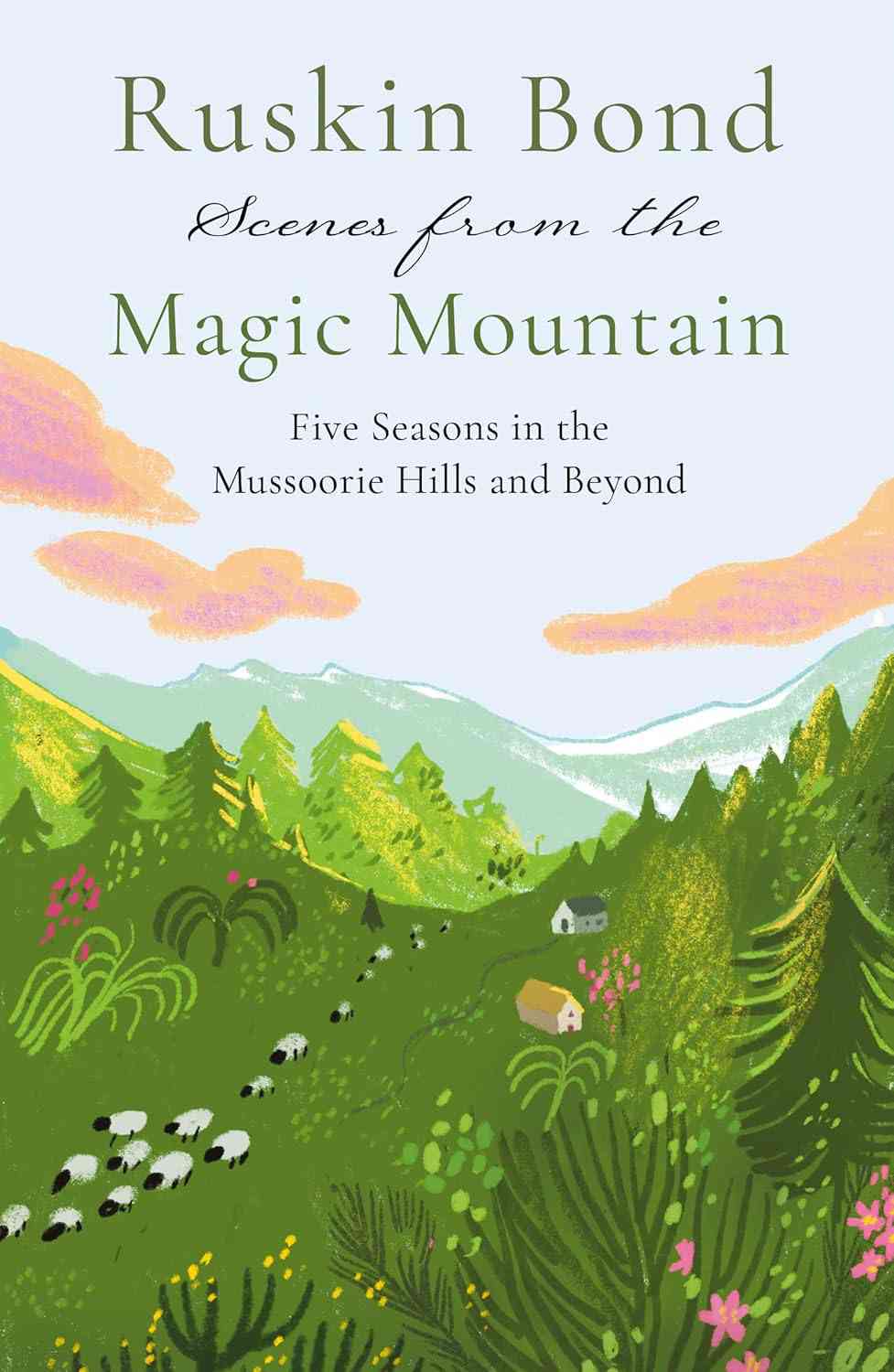
Excerprted with permission from Scenes from the Magic Mountain: Five Seasons in the Mussoorie Hills and Beyond, Ruskin Bond, Speaking Tiger Books.
